Author: raybogman

  • CTO Academy Digital MBA: Grow as a Tech Leader

    CTO Academy Digital MBA: Grow as a Tech Leader

    Most “leadership programs” for tech professionals are a waste of time and money — recycled theory, zero real-world application, and absolutely nothing that prepares you for the brutal complexity of leading technology at scale. The CTO Academy Digital MBA for Technology Leaders is the exception that proves the rule.

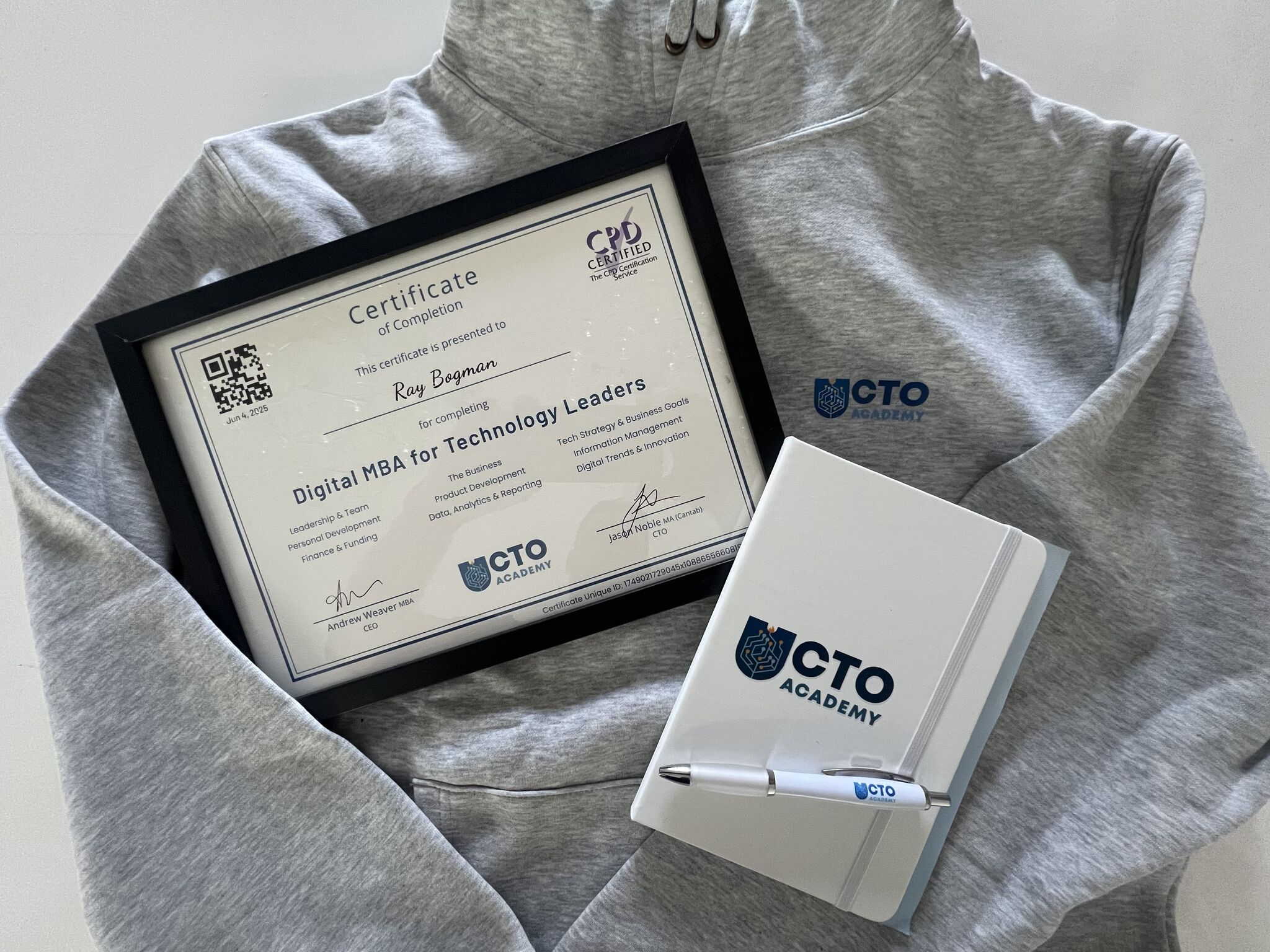
    I recently completed the program myself, and what I experienced challenged my assumptions about online learning, professional development, and what it truly means to grow as a technology leader. This isn’t a sponsored review. This is an honest, direct account of why this program deserves your serious attention — and why doing nothing to invest in your leadership is the most dangerous career decision you can make right now.

    The Conventional Wisdom

    The prevailing belief in the tech industry is simple: if you’re a great engineer, architect, or technical specialist, leadership will come naturally. Work hard, deliver results, get promoted — and the rest will figure itself out. Many IT professionals assume that reading a few books, attending occasional conferences, or completing a generic MBA is enough to make the leap from technical expert to transformational technology leader.

    The result? Talented engineers promoted into CTO, VP, or Head of Technology roles — and left completely unprepared for the strategic, financial, and human dimensions of the job. Technical brilliance alone does not make a technology leader. And yet, the industry keeps pretending otherwise.

    A Different Perspective

    The gap between being technically excellent and being an effective technology leader is enormous — and almost nobody is taking it seriously enough.

    Consider this: a CTO or senior technology leader today must simultaneously manage engineering teams, navigate board-level conversations, understand funding models, drive product strategy, interpret data analytics, anticipate digital disruption, and inspire a culture of innovation. These are not skills that emerge from shipping great code. They must be learned, practiced, and continuously refined.

    This is precisely where the CTO Academy Digital MBA for Technology Leaders steps in and delivers something genuinely different. The 12-month curriculum — also available self-paced for those with demanding schedules — covers nine comprehensive domains:

    • Leadership & Team — building high-performance teams and leading with emotional intelligence
    • Personal Development — becoming the leader you need to be, not just the one you are today
    • Finance & Funding — understanding the financial levers that drive business decisions
    • The Business — connecting technology strategy to commercial outcomes
    • Product Development — bridging the gap between engineering and customer value
    • Data, Analytics & Reporting — turning information into strategic advantage
    • Tech Strategy & Business Goals — aligning technology roadmaps with organisational ambition
    • Information Management — governance, security, and the responsible use of data
    • Digital Trends & Innovation — staying ahead of disruption rather than reacting to it

    What struck me immediately was the quality and intentionality of the content. Andrew Weaver, Jason Noble, and the CTO Academy team have clearly invested deeply in creating material that is relevant, practical, and free from the filler that plagues so many online learning platforms. Every module feels crafted by people who have actually lived the challenges they’re teaching.

    “The best investment you will ever make is in yourself. Not in your tools, not in your tech stack — in your ability to think, lead, and inspire. The CTO Academy Digital MBA is designed precisely for that investment.”

    The bonus content alone — contributed by leaders from across the global technology community — is extraordinary. These are candid, experience-rich perspectives from people operating at the highest levels of the industry. Perspectives you simply won’t find in textbooks or generic MBA programmes.

    Acknowledging the Counterarguments

    Some will say: “I don’t have 12 months.” Fair point — which is exactly why the self-paced option exists. You control the timeline. Others will argue that real-world experience is the only teacher that matters. There is truth in that. But waiting years for experience to teach you what a structured, high-quality curriculum can deliver in months is an expensive and unnecessary sacrifice. The best leaders combine structured learning with lived experience — they don’t choose one over the other.

    Others may question the value of any online programme versus a traditional MBA. Here’s the reality: a conventional MBA costs tens of thousands of euros or dollars, takes years, and was largely designed for general business professionals — not technology leaders facing the specific, fast-moving challenges of the digital economy. The CTO Academy Digital MBA is purpose-built for the world you actually operate in.

    What This Means for Tech Leaders and IT Professionals

    If you are in — or aspiring toward — a technology leadership role, the time to invest in your development is not “someday.” It is now.

    The technology landscape is evolving at a pace that makes standing still equivalent to falling behind. AI, cloud transformation, cybersecurity threats, digital disruption — these forces are reshaping every industry simultaneously. Leaders who understand both the technical and business dimensions of these shifts will be the ones who thrive. Those who remain purely technical will find their influence and relevance diminishing.

    For senior IT professionals, this programme provides the strategic vocabulary and business acumen needed to earn a seat at the executive table. For aspiring CTOs, it provides the framework to step into that role with genuine confidence. For current CTOs, it provides structured reflection and continued sharpening of the skills that define great leadership.

    “Technology leadership is no longer a technical discipline with some management responsibilities attached. It is a strategic, human, and commercially-driven profession — and it demands education that reflects that reality.”

    What Should We Do About It

    Here are my direct, actionable recommendations for any technology professional reading this:

    1. Stop waiting for your employer to invest in your leadership development. Take ownership. Your growth is your responsibility.
    2. Audit the gaps in your current leadership toolkit. Be honest about where your technical strength ends and your leadership capability needs to grow.
    3. Explore the CTO Academy Digital MBA for Technology Leaders — review the curriculum, assess the fit, and take the first step toward structured, meaningful development.
    4. Connect with peers on the same journey. The peer network within CTO Academy is one of its most underrated assets — surrounding yourself with ambitious, growth-oriented technology leaders accelerates your own development exponentially.
    5. Use the 10% discount available through the link below. There is no rational reason to delay when the barrier to entry is this accessible.

    My colleague Alex Gayan and I went through this journey together, and having a peer alongside you makes the experience richer, more accountable, and frankly more enjoyable. If you can, bring someone with you.

    👉 Enrol now and use the discount code for 10% off: https://lnkd.in/evjkys22

    Frequently Asked Questions

    Who is the CTO Academy Digital MBA for Technology Leaders designed for?

    The programme is designed for technology professionals at various stages of their leadership journey — from senior IT professionals aspiring to CTO-level roles, to current CTOs looking to sharpen their strategic and business capabilities. If you work in tech and want to lead with greater impact, this programme is relevant to you.

    How long does the programme take to complete?

    The curriculum is structured as a 12-month programme, but it is also available self-paced, which means you can progress according to your own schedule and professional commitments. This flexibility makes it genuinely accessible for busy technology leaders.

    How does the CTO Academy Digital MBA differ from a traditional MBA?

    A traditional MBA is a broad business qualification designed for general management. The CTO Academy Digital MBA is purpose-built for technology leaders — the content, case studies, guest contributors, and strategic frameworks are all designed around the specific challenges and opportunities that CTOs, VPs of Technology, and senior IT leaders face every day. It is more relevant, more focused, and far more cost-effective.


    The technology leaders who will define the next decade are not the ones who know the most about code — they are the ones who combine deep technical understanding with strategic vision, financial literacy, and the human skills to inspire great teams. The CTO Academy Digital MBA for Technology Leaders gives you the structure, the content, and the community to become exactly that leader.

    Don’t wait for a crisis, a missed promotion, or a performance review to tell you what you already know: leadership is a skill, and skills must be developed. Start today.

    Have you completed the CTO Academy programme or are you considering it? I’d love to hear your perspective — drop a comment below and let’s continue the conversation.
  • AWS Certified AI Practitioner: How I Passed & Why It Matters

    AWS Certified AI Practitioner: How I Passed & Why It Matters

    aws-certified-ai-practitioner-early-adopterMost cloud certifications tell you what AWS can do. The AWS Certified AI Practitioner certification tells the world what you can do with AI — and right now, that distinction is worth everything.
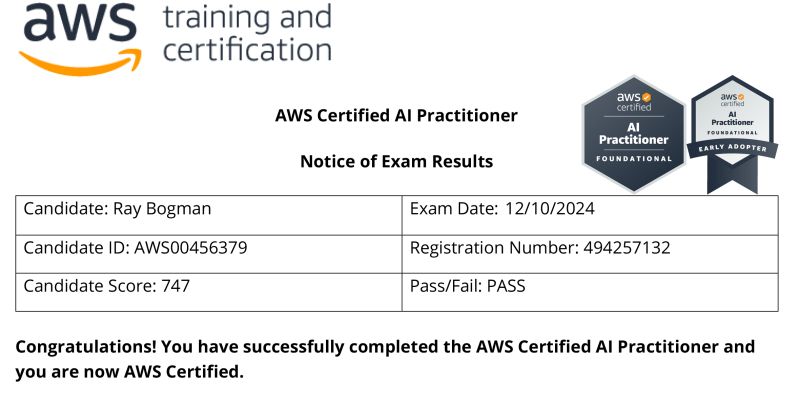
    I recently passed the AWS Certified AI Practitioner exam as part of the early adopter program, and I want to be honest with you: this was not just another badge to hang on a LinkedIn wall. This certification forced me to think differently about how artificial intelligence, machine learning, and generative AI intersect with real-world cloud architecture — and that shift in thinking is already paying dividends in my day-to-day work.

    A huge shout-out to Alex Gayan, who was an outstanding study peer throughout this journey. Having someone to bounce ideas off, challenge assumptions, and hold each other accountable made a measurable difference. Certifications are often treated as solo missions. They don’t have to be.

    In this post, I’ll walk you through the tools I used to prepare, why I believe this certification matters more than people are giving it credit for, and what it means for professionals navigating the AI-driven cloud landscape right now.

    The Conventional Wisdom

    The general consensus in the tech community is that foundational-level certifications are primarily useful for beginners — people with little to no cloud experience who need a structured entry point. The prevailing view is that seasoned cloud professionals should skip straight to associate or professional-level certifications, where the “real” technical depth lives.

    According to this logic, the AWS Certified AI Practitioner is a lightweight credential aimed at non-technical stakeholders, business analysts, or people who just want a credential that sounds impressive without requiring serious effort. Many dismiss it as a surface-level overview of AI concepts wrapped in AWS branding.

    I respectfully, but firmly, disagree.

    A Different Perspective

    The AWS Certified AI Practitioner is not a beginner’s shortcut — it is a strategic credential for cloud professionals who want to lead in the AI era, not just participate in it.

    Here is what the conventional wisdom misses: the AI landscape is moving faster than any single technical specialization can capture. Organizations are not just asking “can you deploy a model?” They are asking “can you understand the responsible use of AI, evaluate foundation models, identify appropriate use cases for generative AI, and communicate those decisions across business and technical teams?” That is a cross-functional skill set — and it is exactly what this certification validates.

    The exam covers a breadth of genuinely substantive topics:

    • Core concepts of AI, ML, and deep learning — not just definitions, but practical distinctions
    • Generative AI fundamentals, including prompt engineering, foundation models, and retrieval-augmented generation (RAG)
    • AWS AI and ML services such as Amazon Bedrock, Amazon SageMaker, Amazon Rekognition, Amazon Lex, and more
    • Responsible AI principles — bias, fairness, transparency, and governance
    • Security and compliance considerations specific to AI workloads
    • Evaluating AI model performance and understanding trade-offs

    That is not a lightweight syllabus. That is the vocabulary and framework every cloud professional needs to be credible in AI conversations — with clients, with leadership, and with engineering teams.

    “In a world where everyone claims to understand AI, the professionals who can demonstrate structured, validated knowledge of AI principles will be the ones trusted to lead AI initiatives. Certification is not the ceiling — it is the foundation.”

    Being part of the early adopter program added an extra layer of significance. Early adopters shape the feedback loop for new certifications — helping AWS understand whether the credential reflects real-world needs. It signals a commitment to staying ahead of the curve, not catching up to it.

    The Tools I Used to Pass

    Preparation was deliberate, structured, and multi-layered. Here is what actually worked:

    • AWS Skill Builder — The official learning platform offered structured learning paths specifically aligned to the exam objectives. The AI Practitioner learning plan on Skill Builder is genuinely well-constructed, and I highly recommend starting here. It includes digital courses, knowledge checks, and exam-style practice questions.
    • AWS official practice question sets — Practicing with real AWS exam-style questions was critical for understanding how the exam frames scenarios. The language and structure of AWS questions has its own logic, and repetition builds fluency.
    • AWS Documentation and Whitepapers — Particularly the AWS Responsible AI whitepaper and documentation for Amazon Bedrock and Amazon SageMaker. Reading primary source material gave me confidence in areas where courses only scratched the surface.
    • Peer study with Alex Gayan — This cannot be overstated. We used a simple accountability framework: weekly check-ins, shared notes on challenging topics, and mock Q&A sessions where we explained concepts to each other out loud. Teaching a concept is the fastest way to expose the gaps in your own understanding.
    • Hands-on experimentation with AWS services — Reading about Amazon Bedrock is one thing. Prompting foundation models directly, testing different parameters, and observing real outputs is another. Hands-on time made abstract concepts concrete.

    “Passive consumption of study material is preparation theater. Active recall, peer discussion, and hands-on practice are what actually produce exam-day confidence — and more importantly, real-world competence.”

    Acknowledging the Counterargument

    To be fair: there is a legitimate concern that certifications can become performative — professionals collecting credentials without translating them into meaningful skills or outcomes. The cloud industry has seen this happen with other foundational certifications.

    That concern is valid. But the rebuttal is simple: the value of a certification is not in the certificate. It is in the preparation process, the structured knowledge it builds, and the conversations and opportunities it unlocks. If someone passes this exam through pure memorization and never applies the knowledge, then yes — the credential has limited value to them. But that is a statement about how they engaged with the material, not about the material itself.

    The AWS Certified AI Practitioner, studied with genuine intent, produces professionals who understand AI at a level that most of their peers do not.

    What This Means for Your Profession

    AI is no longer a specialization — it is becoming a baseline expectation. Whether you are a solutions architect, a DevOps engineer, a cloud consultant, or a technical project manager, your clients and employers are increasingly expecting you to have informed, confident opinions on AI strategy, AI tooling, and AI risk.

    This certification positions you to:

    • Lead AI conversations with clients who are evaluating whether and how to adopt generative AI on AWS
    • Bridge the gap between business stakeholders and technical teams by speaking both languages fluently
    • Evaluate AI services objectively — knowing when Amazon Bedrock is the right choice, when SageMaker is more appropriate, and when neither is the answer
    • Demonstrate responsible AI awareness — which is increasingly a procurement and compliance requirement in enterprise contexts
    • Accelerate your credibility in a market where AI expertise is scarce and demand is accelerating

    What Should We Do About It

    If you are a cloud professional who has been sitting on the fence about this certification, here is my direct advice:

    1. Start with AWS Skill Builder today. Build the learning plan for the AWS Certified AI Practitioner and commit to consistent, scheduled study time. Do not binge-study — spaced repetition works better.
    2. Find a study peer. The value of studying alongside someone like Alex Gayan cannot be replicated by solo study alone. Find someone at a similar stage and commit to mutual accountability.
    3. Get hands-on with AWS AI services. Spend time in the AWS console with Amazon Bedrock, explore the model catalog, and run real experiments. Theory without practice is fragile under exam pressure — and useless in client conversations.
    4. Read the whitepapers. Especially on Responsible AI. Exam questions in this domain reward depth, not surface-level familiarity.
    5. Take the exam before the early adopter window closes. Being an early adopter is a signal. It demonstrates that you engage proactively with emerging technology, not reactively.

    Frequently Asked Questions

    Who is the AWS Certified AI Practitioner certification for?

    The AWS Certified AI Practitioner is designed for anyone who wants to validate their knowledge of AI, ML, and generative AI concepts on AWS — regardless of a specific technical job role. It is particularly valuable for cloud professionals, consultants, architects, and technical managers who need to engage with AI strategy and AWS AI services in their work. No prior hands-on AI development experience is required, but a genuine understanding of cloud fundamentals will help.

    How difficult is the AWS Certified AI Practitioner exam?

    The exam is not trivial, despite being foundational in classification. It requires a solid understanding of AWS AI and ML services, responsible AI principles, generative AI concepts including prompt engineering and foundation models, and the ability to evaluate use cases. Candidates who approach it seriously — using AWS Skill Builder, practice questions, and hands-on experimentation — will be well prepared. Those who rely on memorization alone will likely struggle with scenario-based questions.

    What is the value of this certification compared to other AWS certifications?

    The AWS Certified AI Practitioner occupies a unique position: it is the only AWS certification that specifically focuses on AI, ML, and generative AI as its primary domain. While the AWS Machine Learning Specialty goes deeper into technical implementation, the AI Practitioner certification is broader in scope and specifically designed to produce well-rounded AI literacy. For professionals who work across solution design, client advisory, or cloud strategy roles, this breadth is often more immediately applicable than deep specialist knowledge.

    The Bottom Line

    The AI revolution is not coming — it is already here, and the professionals who invested in structured AI knowledge early are the ones who will lead it. Passing the AWS Certified AI Practitioner exam as an early adopter was one of the most professionally purposeful decisions I have made this year. Not because of the certificate itself, but because of what the preparation built: a structured, validated framework for thinking about AI on AWS that I apply every single week.

    If you are a cloud professional who wants to remain relevant, lead client conversations with confidence, and contribute meaningfully to the organizations you serve — this certification deserves a place on your roadmap.

    Have you taken the AWS Certified AI Practitioner exam, or are you considering it? I’d love to hear about your experience, your questions, or your study strategy in the comments below. Let’s keep the conversation going.

  • Oxford AI Programme Graduate: Leadership Lessons from AI

    Oxford AI Programme Graduate: Leadership Lessons from AI

    oxford-artificial-intelligence-programmeMost leaders talk about AI. Few actually study it. I decided to do both — and what I learned at Oxford changed how I think about leadership, technology, and the future of business forever.

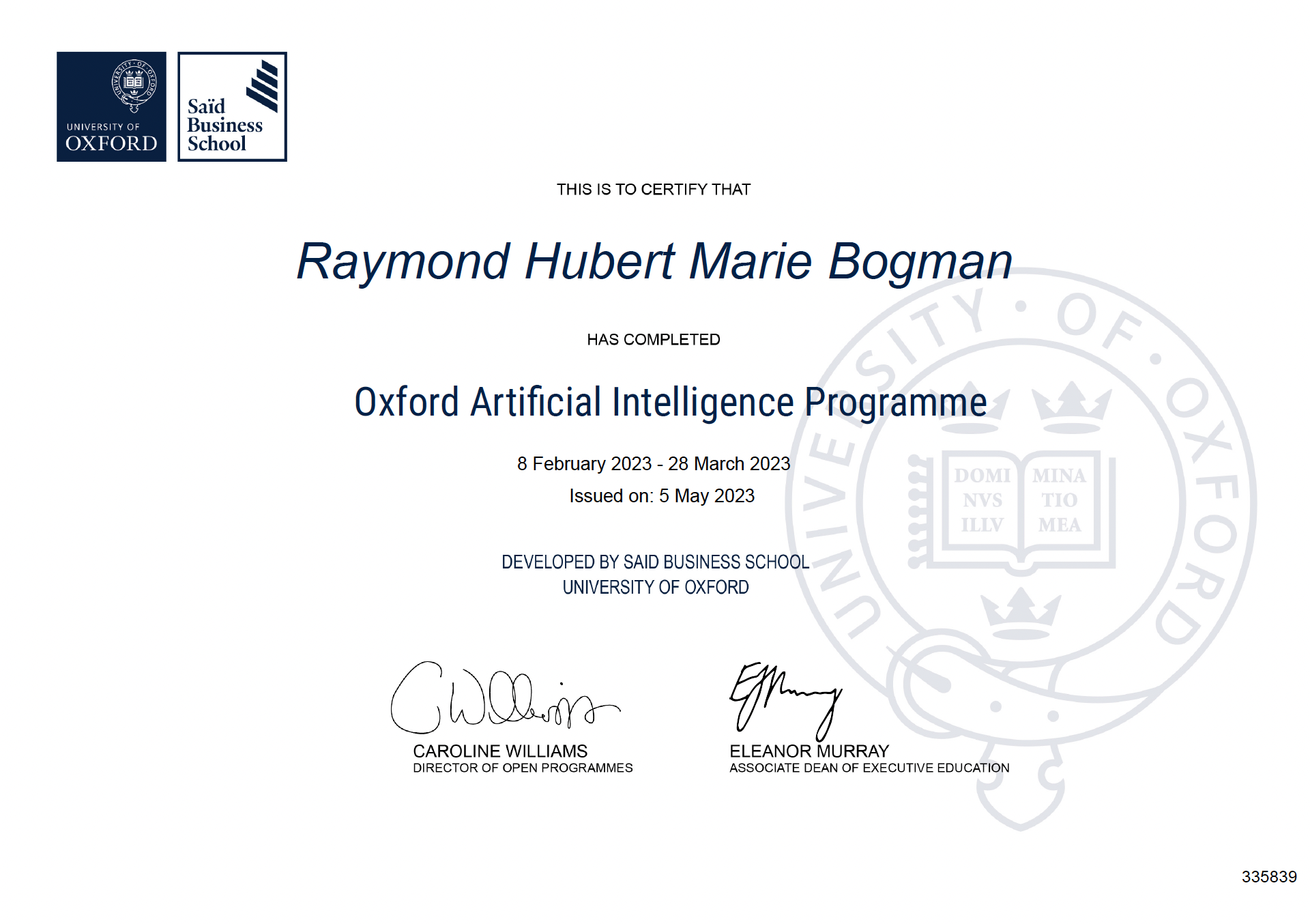
    In early 2023, I completed the Oxford Artificial Intelligence Programme through Oxford’s online learning platform, finishing with an overall grade of 88.9% — above the class average of 83.2%. But the grade is almost beside the point. What matters far more is what six intensive modules of deep, structured learning revealed about where AI is heading, how leaders should respond, and why most organisations are still asking the wrong questions.

    This is not a course review. This is a leadership reflection.

    The Conventional Wisdom

    The prevailing view in most boardrooms goes something like this: “We need to adopt AI. We’ll hire a data science team, plug in some tools, and let the technology do the rest.” Leaders are told to be “AI-aware,” to attend a half-day workshop, to read a McKinsey report, and to delegate the hard thinking to someone with a PhD in machine learning.

    The conventional wisdom says AI is a technical problem. It belongs in the IT department. Leadership’s job is to set the vision and get out of the way.

    I used to half-believe this. Then I spent weeks inside the Oxford Artificial Intelligence Programme — and I no longer believe it at all.

    A Different Perspective

    AI is not a technical problem. It is a leadership problem. And leaders who refuse to truly understand it are not delegating responsibility — they are abdicating it.

    Let me explain what studying this subject at Oxford’s level of rigour actually revealed.

    The programme took me through machine learning, deep neural networks, recommendation systems, image recognition, ethical frameworks, and finally, building a full business case for AI implementation. Each module demanded not just comprehension but application — how does this work inside a real organisation, with real constraints, real people, and real consequences?

    In Module 4, I submitted a project exploring AI’s potential within my own organisation. I proposed a sandboxed CI/CD pipeline approach for AI-assisted code changes — a concept my assessor described as “pretty complex and novel” with “applications in other industries.” That idea didn’t come from a textbook. It came from understanding the technology deeply enough to connect it to a specific operational challenge. You cannot make those connections from a distance. You cannot lead transformation you do not understand.

    In Module 5, I developed a set of ethical principles for AI deployment, earning 100% — and more importantly, earning feedback that highlighted my emphasis on responsibility as a standout element. That is not an accident. Responsibility is a leadership word. It should sit at the centre of every AI strategy, not as a compliance checkbox, but as a cultural commitment.

    “The most dangerous leader in the AI era is not the one who knows nothing about the technology. It is the one who knows just enough to be confidently wrong.”

    Even my lower-scoring modules taught me something critical. In Module 1, I analysed why VHS beat Betamax — a case study about technology adoption that has direct parallels to AI today. My assessor pushed me to go deeper on accessibility and affordability. That feedback stung slightly, but it was correct. The best technology does not always win. The most accessible, most trusted, most human-friendly technology wins. That is an insight every AI leader needs tattooed on their wall.

    In Module 3, I was pulled up for answering the question I wanted to answer rather than the one being asked — specifically around image recognition features. Again, a leadership lesson hiding inside a technical critique: listen precisely, respond precisely, and never assume you already know what the problem is.

    Counterarguments — And Why They Fall Short

    Some will argue that leaders don’t need to understand the mathematics of gradient descent or the specifics of q-learning versus modern reinforcement learning approaches. Fair point — and the Oxford programme itself would agree. The goal is not to turn executives into engineers.

    But there is a significant gap between understanding everything and understanding enough. Right now, most senior leaders sit far too close to the “nothing” end of that spectrum. They cannot evaluate vendor claims. They cannot challenge their own data science teams. They cannot identify where AI will create genuine value versus where it will generate expensive noise. They cannot make ethical judgements about deployment without understanding what is actually being deployed.

    Structured, rigorous education — not a podcast, not a LinkedIn post, not a conference keynote — is what closes that gap. The Oxford Artificial Intelligence Programme is built precisely to serve that purpose, and it delivers.

    What This Means for Business Leaders

    If you are in a leadership position in 2024 and beyond, here is what my Oxford experience tells me you need to face squarely:

    • Your competitors are not waiting. AI is already reshaping recommendation engines, customer support, code development, and operational efficiency. The organisations pulling ahead are those where leadership understands the tools well enough to deploy them intelligently.
    • Ethics is now a strategic function. The EU AI Act, growing public scrutiny, and high-profile AI failures mean that responsible AI governance is not optional. Leaders need the conceptual framework to design and enforce ethical principles — not just sign off on a policy document someone else wrote.
    • Your instincts about technology adoption are probably wrong. The VHS lesson applies directly to generative AI tools, large language models, and automation platforms right now. The technology that wins will be the one your customers and employees trust and find accessible — not necessarily the most technically impressive one.
    • A business case is not a vision statement. Module 6 taught me that an AI business case must address genuine organisational needs, measurable outcomes, and realistic implementation pathways. Vague AI ambition is not strategy. It is noise.

    “Leadership in the AI age demands the courage to learn publicly, the discipline to go deep, and the humility to let the evidence change your mind.”

    What Should We Do About It

    Here are my direct, actionable recommendations for any leader serious about navigating the AI era:

    1. Invest in structured education, not just awareness. Enrol in a programme like the Oxford Artificial Intelligence Programme. Commit the 7–10 hours per week. Do the assignments. Accept the feedback. This is non-negotiable if you want to lead transformation credibly.
    2. Apply learning to your own organisation in real time. Every module I completed, I connected directly to my organisation’s context. This is not theoretical — it is operational preparation. Start doing this from week one.
    3. Build ethical frameworks before you need them. Do not wait for a crisis to develop your AI ethics principles. Draft them now, test them against real scenarios, and embed them into your governance structure.
    4. Challenge your AI vendors and internal teams. Once you understand the basics of machine learning and deep learning, you will start asking better questions. Better questions lead to better decisions and far fewer expensive mistakes.
    5. Be honest about where your knowledge ends. One of the most valuable things rigorous study teaches you is the precise shape of your own ignorance. Know it. Name it. And then go close the gaps.

    Frequently Asked Questions

    Is the Oxford Artificial Intelligence Programme worth it for non-technical leaders?

    Absolutely — and in many ways, it is designed for non-technical leaders. The programme builds conceptual understanding of machine learning, neural networks, and AI ethics without requiring a background in mathematics or programming. The emphasis is on strategic application: how do you identify AI opportunities, evaluate risks, and build a compelling business case? If you are a senior leader, a manager, or an entrepreneur, this programme gives you the vocabulary and frameworks to lead AI initiatives with genuine credibility.

    How difficult is the Oxford AI Programme, and how much time does it require?

    The programme requires approximately 7–10 hours per week across six modules. The difficulty is real — assessors provide substantive, critical feedback, and high scores require genuine engagement with the material, not surface-level responses. I scored between 56% and 100% across different assignments, which reflects the varying complexity of each module’s demands. Expect to be challenged. That challenge is exactly what makes the qualification meaningful.

    What is the most important leadership lesson from studying AI at this level?

    That responsibility cannot be delegated. You can delegate execution. You can delegate technical implementation. But the decision to deploy AI in your organisation — and the accountability for what it does to your customers, your employees, and your culture — sits with leadership. Understanding the technology is what makes responsible decision-making possible. Without that understanding, you are not leading. You are hoping.

    The Bottom Line

    Completing the Oxford Artificial Intelligence Programme with an 88.9% overall grade is something I am proud of — not because of the number, but because of what earning it required: genuine effort, intellectual honesty, and the willingness to be wrong in order to learn.

    AI is the defining leadership challenge of our generation. It will not wait for you to feel ready. It will not slow down while you finish your current priorities. And it will absolutely not be led well by people who have never taken the time to truly understand it.

    If you are a leader who is serious about navigating this era — not just surviving it, but shaping it — I would strongly encourage you to explore the Oxford Artificial Intelligence Programme for yourself. And if you have already taken a similar journey, I want to hear from you.

    Drop a comment below: What has been your most important AI learning as a leader? Let’s build this conversation together.